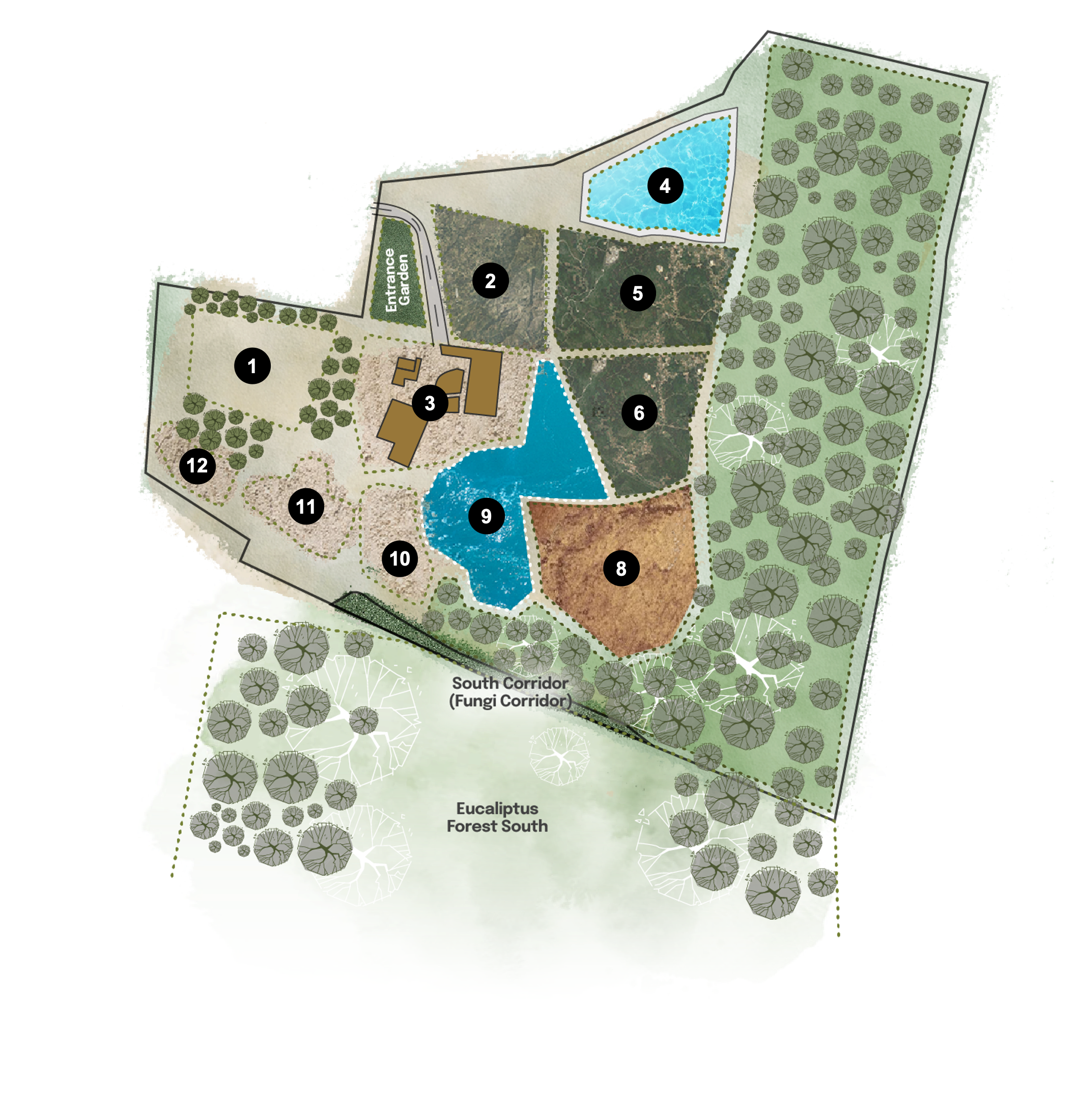
Zoning Overview
Developed in partnership with Depasture, this zoning project looks at the land through the lens of its ongoing activities and natural dynamics. Each zone is examined individually to better understand its current state, uncover its potential, and address its challenges, resulting in a set of clear, informed recommendations for responsible management and future development.
1. Housing Zone
Housing zone is the one on the west side of the property and is dedicated to housing of the inhabitants of the Quinta. It currently consists of a bare-land citrus area, apple trees, oak trees and biodiverse permanent pasture on the west side of the main house. Final foundation movements are yet to take in that part of the property for it to be finalized.
4. Bio-Pool Zone
Here we have the example of bad machine use: pool regard the design itself, but for the ability of the design to allow and retain water. The impact, in this case, was noticeably negative and now the question is: how do we get back on track? In the final recommendations, we mention cover crops as a very effective way to counter stack erosion immediately. This said, this area needs a final design for the landscape around and the movement of water, and just very appeasable carpentry can follow.
7. Native Forest Zone
A mature forest where pine and eucalyptus are well balanced in both strata and edge. Our suggestion here is then to slowly regenerate it by intentional pruning. The objective is to allocate all the carbon from old trees and branches that, and then slowly apply chop and drop practices, where some of the pine, myrtle, and arbutus can be cleared out but the organic matter stays in the same forest and it will be digested and allocated somewhere else.
Disturbed Zones
We have decided to separate this zone to differentiate that in this one there is mature forest. If well pruned, the system can be maintained as a mature forest and use it as a space carbon for the community. As a mature forest, it made us think that it could be a potential place for a food chicken coop, since the ground is already covered and the chickens could not over pasture. Yet other spaces should be considered when putting together the final design.
2. Restaurant Zone
We don’t foresee any problem with the area, besides the necessity of a good hydrological design with bio-pools and the gardening/forestry that is planned to go next to it. In the final recommendations we consider this and therefore think the bio-pool approach is key for landscape design and also to coordinate other constructions close to the area.
5. Agroforestry Zone 0
North west of the property, next to the bio-pool and on top of the community kitchen, this space is seen in so many angles. The current idea of a market garden is in the concept. There are no trees established and the area is now degraded. With a final design and the right machinery move, the space can be revitalized. Fertile soil is not a difficult resource to create, so with the right key line, a productive, beautiful garden can be established. We recommend that agroforestry is implemented in combination with keyline design method. In this way both yield and carbon sequestration are maximized, and water can be absorbed.
8. Roca Madre Zone
One of the spaces that we liked the most and that has very specific characteristics. Our approach here is to try to accommodate with the nature. We are highlighting that the potential area of roca madre gives huge micro water ecosystems and the way down to the water zone, and this will prevail this way. Our opinion is to embrace the beauty of it and the connection to the water zone and to design accordingly.
11. Disturbed Zone 2
This space just under the kitchen. To highlight, there is a critical erosion point and it has to be taken care of. In addition, as a south-facing slope, it has a lot of potential. Definitely gardening and agroforestry can be implemented. For structures, it is also flat and circular, so it can accommodate some of the different ideas that are on the table.
3. Coworking and Office Zone
This zone is in its final stage and all seems in place. On the construction there is one more space to finish connected to a small but key aspect of the hydrological system to be decided. In the final recommendations, we suggest a final map on structure, hydrological design, and gardening. This way, when the machinery is brought in to finish all details of the construction, the hydrology around is already clear and can also be tackled for permanent solutions.
6. Agroforestry Zone 1
We have decided to separate this zone to differentiate that in this one there is mature forest. If well pruned, the system can be maintained as a mature forest and use it as a space carbon for the community. As a mature forest, it made us think that it could be a potential place for a food chicken coop, since the ground is already covered and the chickens could not over pasture. Yet other spaces should be considered when putting together the final design.
9. Water Zone
The wettest spot in the land where all water connections meet, before the land moves out the south west. The area is key to regenerate itself from the last disturbances and all the ground is already covered. On one side, we suggest to avoid construction with foundations. On the other hand, to add plant diversity since the place is very fertile and there is water available for more vegetation. Ecological construction along with biodiversity landscaping can allow for beautiful social spaces along with the amphitheater vision.
12. Disturbed Zone 3
We decided to split this zone into a 3rd part, because it has specific characteristics. First, it connects the road that goes through the village through the south part. Also, it is the closest of the three, so it would be the best place for gardening or for parking. So, with its own category, it is open to think about what will be the function of it. As all the others, the description of its layering and specific site analysis was made using the potential landscape context.